

|

Welcome to the NWHS Article Archive
Articles are posted here one month after their appearance in the magazine, except for cover stories, which are posted concurrently with the magazine's release.
Copyright to all content is held by The Northwest Horse Source LLC and/or the article's author. If you would like to reprint or repost an article, please contact us. Feel free to link to any article on this site from your own blog or website.
Horsing Around Montana
A world of horse opportunities, all in one state
A state that defines the quintessential “Wild West,” Montana is a place for families, friends or individuals to experience new adventures on horseback. Rolling green hills, deep blue skies and a quiet atmosphere create a haven for horse folk, whether they're coming from just across a county line or all the way across the country.
Residents will tell you the Montana attitude is unique, relaxed and peaceful. Linda Olson from Bitterroot Therapeutic Riding in Corvallis says being in Montana is like going back in time to enjoy the wide open spaces without the hustle and bustle.
From the mountain ranges in western Montana to the flat plains on the eastern side of the state, there are hundreds of equine activities for all ages and interests. VisitMT.com lists more than 60 rodeos and fairs throughout the year and more than 200 ranch vacations, outfitters, cattle drives and trail riding opportunities.
Labels: Feature Stories, February 2009, nicole lanphear
February Spotlight
Back Country Horsemen of America Represents You, Too By Sarah Wynne Jackson
Many of us dream of taking our horses out on wide expanses of untouched land, but the reality is that some of us reside in urban and city areas. Depending on where you live, “back country” might be a 50-acre town recreational area or an old railroad bed. These front country lands are the only safe places some equestrians have to get their horses out of the arena and to experience a taste of traveling by horseback. Back Country Horsemen of America believes that every trail used by horses is valuable and worthy of the effort of maintenance and preservation. If you want to know more about Back Country Horsemen of America or become a member and help keep all kinds of trails open for others, visit www.backcountryhorse.com.
***
Honda Generator Review by Karen Pickering
The Honda EU2000i generator is great for that extra power you need while traveling or camping remotely. The compact unit is great for charging up your RV battery, cooking a microwave dinner, or watching TV (for those who can’t live without).
I found the generator simple to use and super easy to start. The instructions were good and we were up and running in no time. The unit snuggled nicely into my trailer’s tack room, right under my blanket rack near the water tank. It was easy to access, and because it was so lightweight, it was easy to get out for quick use. Overall, the model is safe, secure, and simple to use and store. Great for someone like me who does a lot of camping on my own. If I can figure it out, you can be sure it’s easy to use!
I was certainly never short of people wanting to borrow it! This unit can be used to jump start your truck battery or run additional lighting for an event if you have the proper connections. It even ran music for us during a big event this summer. The motor is so quiet you hardly notice it’s running.
I definitely recommend this unit for those who enjoy remote camping. I know I’m good for about three days of camping without a power source, but much more than that and I need to recharge. Having a generator makes an extended stay possible, and comes in very handy for so many uses at home and away.
I would recommend a larger unit for trailers with high powered A/C that requires a little more wattage, but the tradeoff would be a loss of portability. If you're looking for something lightweight and practical to get the job done, the EU2000i fits the bill.
***
Exotic Getaway: Sunsets, Saddles & Shiraz Ever dreamed of the droving life, just you and your trusty steed, the red desert below and endless blue skies overhead? Sunsets, Saddles & Shiraz is a new authentic Australian Outback experience combining the rustic romance of cattle droving, gourmet food and wine, native wildlife and the breath-taking Flinders Ranges -- one of the most ancient, remarkable landscapes on earth.
Expert drovers will match you to your mount, and before long you’ll be ambling along on horseback, feeling the sun on your back, seeing magnificent landscapes, and smelling the desert at dusk. You’ll learn to identify various animal tracks and native plants. You’ll enjoy a fresh packed lunch and billy tea in a shady creek bed. And you’ll tail the cattle until late in the afternoon, with the sinking sun guiding you into the station yards for the night.
To find out more about this unique equine getaway, visit www.prairiehotel.com.au and click on Sunsets, Saddles & Shiraz.
***
The 2009 International Lusitano Collection Auction Gallops into Florida During the weekend of February 19-20, 2009, members of the equestrian community and South Florida social scene will gather at the 111-acre Jim Brandon Equestrian Center in Wellington, Florida, for the second annual Lusitano Collection Auction. The prestigious event will indulge guests with lavish cocktails and a gala dinner, courtesy of The Lusitano Collection. The event is open to the public for a fee.
Guests may view and examine over two dozen horses during the week prior to the auction as well as shop at various sponsors’ tents. While the Lusitano Collection is a trademark created by five premier world breeders of the Lusitano horse, this year’s collection will only include horses from Interagro Farms, the largest Lusitano breeder and exporter in the world, and Coudelaria Rocas do Vouga of Brazil.
Labels: February 2009, Spotlight on the News
Horse Play Your Way
Make learning fun for you and your horse!
by Allison Trimble
The reason I began writing this column was to encourage everyone to come out and be a part of this great industry. I was hoping to be the bridge between beginners and trainers. Since I have hung out my shingle, I have been looking for other Northwest trainers who are open to beginners. This winter I was fortunate to find another person who shares a lot of my vision: Natalie Vonk has designed her program in a way that allows riders of all levels to participate. In my first trip to Canada to visit her, I was introduced to the ball. As trainers or beginners, we all can find it hard to stay fresh and motivated. I had a blast playing on Pinball (Natalie’s horse) with the ball and couldn’t wait to bring this experience--and Natalie--to all of you!
Allison Trimble: Introduce us to the ball! Natalie Vonk: It is a 40" canvas-covered ball used as a tool to help you with schooling your horse, developing your natural aids, and at the same time, having a lot of fun! We use this ball in lessons and clinics to encourage the horse to want to learn and for riders to feel a balanced turn with focus and learn correct leg and rein aids while strengthening their seat. We find that even the shyest horse is very attracted to learning the ball within a very short time. Naturally, they are very curious and get hooked quite quickly once they learn that they are the power behind the ball.
AT: When you train horses/riders on the ball, what is the process you go through? NV: Often, we introduce the horse and rider on the ground to help both read each other and learn to work through the horsemanship and communication needed to learn to team up and push the ball. While strengthening a rider’s horsemanship on the ground, they develop the trust and the direction needed to make contact with the ball. We start with teaching them how to drive their horse around the ball, then use pressure and release to intrigue the horse. Horses are curious by nature and become very attached to the ball as they learn to make the ball retreat, which builds a desire to put pressure on the ball themselves. It is very exciting to watch riders communicate with their horses to trust them and then take the direction to push the ball with the horse's nose or feet. Once a rider can make the ball travel in front of the horse by using nose or feet, then we start asking them to change directions on the ball to educate each eye. Learning to weave the ball through cones or to hit the ball to a target is only a small amount of the fun that you can have challenging your horsemanship skills and communication.
AT: How does this apply to reining? NV: In order to move the ball efficiently from [the horse's] back, you need to develop good shoulder control and quiet guiding with your hands. I find that the ball often gets the horses more sensitive to leg and seat aids, which keeps them lighter in the bridle. The ball is also an excellent way to freshen the horse that has become dull in the arena, as it creates an interest and natural drive in the horse, not unlike figuring out that the ball is below them in pecking order and easily moves off of their own horsepower. Not only shoulder control is improved, but you can really work on your lateral body control and see results.
AT: How does this apply to cow work? NV: We have had a lot of fun relating the positions of work on cattle to those of working on the ball. You need to keep your horse balanced through its hind end and light through the shoulders to sweep around the ball. You can build “shape” on the ball while gaining a better feel for your horse’s body control. I have found that this is a great tool to bring out more confidence in horses that have not been consistent in their focus on a cow or have been too nervous to become engaged. The interest gets so strong that in some horses you can work the ball bridleless after only a few times working it.
Allison: Why is this concept such a benefit to beginners? Natalie: This is the most amazing tool to use for beginners because the ball helps riders have focus and fun while developing their seat, leg and hands. The ball creates a fun way to feel when the signals are correct and see the results. The ball inspires riders that have been timid in the saddle and encourages those who are unsure of their signals to their horses. Teaching riders how to use their aids more effectively, creating feel and building their timing, becomes easy.
About Natalie Vonk and Horse Play Your Way Natalie has taken every opportunity to expand her knowledge and ride under many gifted trainers in many disciplines. She sees learning as a lifelong adventure and the horse as an amazingly rewarding partner and teacher along the way. Her facility is proud to be the home of the green horse/green rider, but they are capable of helping the most advanced riders as well. Learn more about Natalie and her program at www.horseplayyourway.com.
Labels: allison trimble, February 2009, On the Plus Side
Free Up the Hips
Gymnastic Exercises for Horse and Rider, Part 2 by Alice Trindle
Use haunches-in maneuvers to free up the hips
Last month we began a series of articles on gymnastic exercises to help flex and supple both the horse and rider. This month, let us focus our attention on the hips and hindquarters of the horse.
Here are some reminders regarding definitions of terms commonly used in almost every equine discipline. However, sometimes these terms have different meanings or mental pictures attached to the maneuver, based on culture, geographic location, and inadequacies of translating from one language to another. Below are the Alice Trindle versions, so at least within this series of articles we are all on the same page!
Basic Terms Bend: The slight arc in the horse's body to the right or left, just enough to see the eyelash in most cases, unless accomplishing suppling and flexing exercises.
Inside or Active Rein: The rein on the inside of the bend (i.e., in a bend to the left, the left rein is inside). The rider's fingers act in a hold-and-release or "sponge" fashion.
Outside or Supportive Rein: The rein on the outside of the bend (i.e., in a bend to the left, the right rein is outside); fingers act in a support or "suggestive" hold or feel.
Movement Terms Shoulder-in: A maneuver in which the shoulders come slightly off the line, toward the inside of the arena, and ultimately three hoof prints are left (a three-track); the balance of the movement starts with the inside hind foot and flows to the outside shoulder and outside rein. The rider's weight/balance sits slightly in the direction of travel.
Haunches-in or Travers: A maneuver in which the hindquarters come slightly off the line, toward the inside of the arena, and hoof prints are a three-track; the balance of the movement begins with the outside hind foot and flows to the inside shoulder. The rider's balance sits in the direction of travel, to the inside of the bend
Half-pass: Traditionally accomplished on the diagonal line, bend and movement are sideways, both in the same direction (i.e., bend to the left and movement forward and sideways to the left). The rider's balance is to the inside of the bend, in the direction of travel, with the energy flowing from the outside hind foot to the inside shoulder.
Leg-yield: Traditionally accomplished on the diagonal line with the movement sideways opposite the bend (i.e., bend to the left and movement forward and sideways to the right). The rider sits or balances in the direction of travel or to the outside of the bend.
Reverse or Counter-bend: Posture and movement is similar to the leg-yield, but with less forward movement and the shoulders reaching more than the haunches.
This Month's Exercise
What: For this exercise, you'll be riding the long side of the arena with haunches to the inside, keeping this posture as you ride a large circle, then continuing down the long side in a haunches-in maneuver.
Why: To engage and strengthen inside hind leg, hip, and hock; flex the ribcage; soften the jowl; prepare for half-pass postures; and help horse and rider understand precise use of aids.
When: I use the haunches-in postures with horses at all stages of development, as soon as I have established willing movement forward with rhythm and balance. Normally, I begin schooling the hindquarters-in from the ground as a work-in-hand exercise. For the young horse, it helps to establish patience, listening to your aids, and connecting your focus and positioning to the feet. For the advancing horse that has a good grasp of the aids and free hips, I rarely use the haunches-in, but instead more half-pass exercises.
How: Here again I use the square corner to help me visualize the geometry of this exercise. As I ride into the corner, tracking right, I double-check that I can see the horse’s right eye and a wrinkle or two in his jowl, keeping soft and a little gathered. As we progress through the corner, I picture his hips staying to the inside of the track as my focus picks up the new line and my balance shifts slightly from center to the right. I put a little "feel" in the right rein and place my left leg back slightly to encourage the hip to step to the right. I feel for the movement or energy flowing from the left hip to the right shoulder and rein. The bend stays to the right. As I approach the middle of the long side, I picture a large circle, then ride the horse's shoulders on that circle with his haunches slightly to the inside. When I reach the track again, I flow off in the same posture (haunches-in) for a few steps, then straighten and reward.
Cautions: Boy, this exercise is a big one for trying too hard, but that is just setting it up for frustration in both horse and rider. Relax, visualize, try it first on your two-leg horse, and then in ground school. By the time you attempt under saddle, the horse will be there! Remember, too, that you are not pushing the hips away with your outside leg, but rather inviting him to come into your inside leg, following the balance of the movement. In the beginning, reward the first steps and build on that, holding the haunches-in posture longer and longer.
Now it's time to move up the scale and free up those hips! This month, start combining the January "Square Corner" exercises with this haunches-in maneuver. Your horse will become more supple, responsive, and I bet happier!
References: Gymnastic Exercises for Horses by Eleanor Russell Riding Essentials by Francois Lemaire de Ruffieu
Labels: alice trindle, Beyond the Basics, February 2009
Creating the Perfect Paddock, Part 3 in a 3-part series
Put your new paddock to good use
In this series we have covered key techniques for setting up and managing the perfect horse paddock. This month we wind up by discussing how to integrate your paddock into your management system, along with how to deal with horse boredom.
Paddock to Pasture You’ve done everything to set up the mud-free, dust-free perfect paddock, so now you’re ready to integrate everything into your horsekeeping system. If you have pasture, your horses should be kept in their paddocks during the winter and early spring when grass plants are dormant and soils are soggy. In the summer, use your paddock to avoid grazing pasture below three inches. Having a well-maintained paddock is also useful for separating or confining animals, for controlling the amount of grass or feed your horse consumes on a daily basis (so he doesn’t become overweight), and for caring for sick or injured individuals.
Remember to begin springtime grazing time gradually. Too much pasture can cause serious problems, especially in the spring when grasses are green and full of sugar. Start with about an hour of grazing at a time and work up to several hours over a period of weeks. If you have any questions on this, consult your veterinarian for recommendations.
Beating the Boredom Some horses confined in a paddock will develop boredom issues, but luckily there are a few things we can do to help alleviate the problem. The first is to feed more frequently. Smaller, more frequent meals mimic a horse’s natural behavior. If this isn’t possible, consider leaving additional lower quality hay for your horse to browse during the day. On the advice of your vet, perhaps you can reduce the overall quality of hay you feed and increase the amount.
Other boredom-busters include horsey toys; a variety of toys are on the market these days, including balls, licking toys (with sugar or salt in them) or objects with a food treat inside that encourage the horse to pursue the toy. You may be able to make your own toys, perhaps a ball or some other safe plastic object, a plastic milk jug the horses can bat around, or even a heavy branch from a non-toxic tree species--check with your veterinarian for advice on local tree species that aren’t toxic.
The very best method for reducing boredom in your horses is to provide more mental stimulation: riding and exercise. Even though your horses can move around in their paddocks, they still need regular exercise, so plan and maintain a regular program for your horse. Exercising a horse as little as 30 minutes per day three times a week can make a big health and attitude change. Horses (like their humans) need regular exercise as part of their standard care regime. Options include riding (of course!), hand walking, lunging, round pen groundwork, or using a hot walker. Perhaps now is the time to work out a riding and ground exercising routine that will fit your schedule and will benefit your horse.
Healthy Farm, Healthy Horse By utilizing a confinement area as outlined above, you will have less mud and runoff, less dust, fewer flies, and reduced odors as well as healthier pastures. All this means healthier horses, fewer vet bills, less money spent on supplemental feed, a place that’s easier for you to care for and to look at and enjoy, and a cleaner environment for all. That’s perfect!
Happy Horsekeeping, ~Alayne
Labels: alayne blickle, February 2009, Horse Farm Management
Equine Osteopathy
A scientific approach to healing the whole horse
Article and photos by Karen Brown
Many techniques initially developed for humans eventually find their way into veterinary medicine. Among the modalities that have been adapted to the animal world is osteopathy. It was originally developed over 100 years ago as a means to detect and heal disease in the human body. The premise of osteopathy is that a living body is an inter-related entity with an inborn ability to maintain or return to optimum health provided that the structure, or musculo-skeletal system, is functioning within the boundaries of its natural balance.
Virtually any discrepancy from normal function can be assessed in an osteopathic examination. The first rule of observation is that everything means something.
Who Uses Osteopathy? Olympic dressage riders and world champion cutters, ropers, and barrel racers are only a small segment of horse people who use osteopathy as a means to keep their horses in top physical condition. Indeed, these trainers and riders readily admit that regular osteopathic treatments have kept their horses winning at the top competitions in their sports. These horses are also competing longer and more frequently than their same-age counterparts.
There are hundreds of symptoms that might indicate the need for an osteopath. Given the interconnection between the musculo-skeletal system and the rest of the body, it is quite common to have a lameness issue that is caused by a problem somewhere else in the body. Any type of persistent resistance or unwillingness to flex or bend is a sign that the horse could have a structural blockage.
For example, a horse with a heavy parasite load will have a group of blocked vertebra in the thoracic spine. Another horse with an infection in any organ in the pelvic room will have a group of blocked vertebra in the lumbar spine. Horses with these kinds of visceral disorders will have difficulty moving freely, even when the disorder may not yet be detectable by clinical testing. Visceral disorders must be treated by a veterinarian; once they have been resolved, the osteopath manipulates any remaining structural or visceral imbalances. The horse then regains ultimate freedom of movement.
About the Author Karen Brown is a freelance writer on all topics equine as well as a horse trainer and boarding facility owner in Bandera, TX. Her articles have been published in national and regional magazines over the past 11 years. Karen trains all breeds of horses, restarts problem horses, and provides instruction in natural horsemanship through lessons and group clinics. She may be reached at solitaireranch@indian-creek.net or 830-796-4764.
Labels: Equine Wellness, February 2009, karen brown
Pony of the Americas: Doing it All
 The Pony of the Americas breed was established in 1954 in Iowa and has grown from Black Hand, POA #1, its founding stallion, to a registry of over 50,000 and spread beyond the Americas and into Europe.
The breed standard requirements are 44 to 56 inches in height, the head should be small and dished as the Arab, the body muscled as the Quarter Horse, and the coloring must be Appaloosa visible at 40 feet. Crossings of Arab, Appaloosa, Welsh and Quarter Horse have established that “little horse” look of the POA. In both blanket and leopard patterns, the spots may be darker in the middle with a lighter ring surrounding the spot. This look is called a halo.
The national POA organization has grown to include state clubs, state shows, regional shows and sales, and a world class International Show as well as Eastern and Western Classic shows. POAs can earn Register of Merit awards for halter, performance and gaming. A POA earning all three receives the highest of all awards, the Supreme Champion designation.
The POA is bred to be a gentle, loving mount, and children often exhibit even stallions in the breed. The POA is bred to do it all and do it all day long. The same pony and rider will often compete in halter, showmanship, English flat, over fences, western pleasure, reining, trail, cart and gaming classes all in the same show; the following weekend they'll be hitting the woods for leisurely trail rides. POAs are suitable for youth and adult riders and classes are available for both. POAs truly are the “do it all” breed for someone wanting a smaller mount that can both show well in the ring and be a trail riding best friend.
Information and photos courtesy Washington State Pony of the Americas Club. For more information, visit www.poac.org.
Labels: Breed Profile, February 2009, nwhs staff
AAEP Convention Highlights
A review of the 54th annual AAEP convention
by Dave Sauter, DVM, Kulshan Veterinary Hospital
The American Association of Equine Practitioners (AAEP) is a non-profit organization for equine veterinarians. Founded in 1954 in the basement of a Louisville, Kentucky hotel with eleven charter members, the AAEP has expanded to over 9,000 veterinarian and student members in 64 countries. The mission of the AAEP is to protect the health and welfare of the horse through equine research, public education programs, involvement with animal welfare affairs and ethics, and professional development programs for its members.
2008 Convention Highlights This year over 3200 veterinarians, students and veterinary technicians from around the globe gathered in San Diego, California from December 6-10 for the annual AAEP convention. Total attendance exceeded 6500, representing the third-largest turnout in the convention's history. Over 100 scientific papers were presented along with a huge selection of less formal “Table Topic” meetings on myriad subjects including lameness, an in-depth focus on laminitis, neurology, reproduction, dentistry, internal medicine, imaging, neonatology, emergency care at equine events and more.
The “Kester News Hour,” designed to present topics either too recent or too brief to be included in the regular meeting, was one of the highlights. The late General Wayne “Sage” Kester, a native of Nebraska, helped form the AAEP in 1954 and was instrumental in forming the American Horse Council and numerous specialty groups within veterinary medicine. Dr. Kester was an avid horseman who remarked at age 90 that little had changed for him as he got older except life insurance salesman didn’t pursue him anymore and he no longer purchased green bananas.
Another highlight was the Frank Milne State of the Art lecture. This year’s speaker was Dr. Stephen Reed, a 1976 graduate of The Ohio State University who is considered an expert in the field of equine neurology. He is the author of over 150 published articles, editor of Equine Internal Medicine (a textbook for veterinarians) and co-editor of the book Equine Neurology. He lectured on many aspects of equine neurology, including the neurological examination of the horse, wobblers syndrome, equine protozoal myelitis (EPM), and herpes (Rhino). Dr. Reed reviewed many advances in equine neurological diagnostics and treatments that are helping horses survive, commenting that “neurological disease is no longer a euphemism for necropsy.”
Scholarships and Charity The AAEP Foundation is the charitable arm of the AAEP, founded in 1994 to unite individuals and organizations dedicated to improving horse health and well being. The foundation supports research in equine lameness, laminitis, colic and other areas. This year, the foundation's live and silent auctions raised over $118,000. In 2008 alone, the foundation awarded 48 scholarships totaling $190,000 to help fund the education of veterinary students committed to equine careers, assisting them with the estimated $106,000 of debt the average new veterinary graduate faces.
Horse Owner Highlights Veterinarians aren't the only ones who benefit from attending the convention. The Healthy Horses Workshop, an educational day designed just for horse owners, featured seminars on subjects such as eye diseases, training and control from the ground, pain-free saddle fitting and nutrition. Also, Gina Miles spoke about her experiences as a silver medalist in eventing at the Olympics.
Recognizing the vital role of farriery and podiatry to the health and welfare of the horse, the AAEP once again organized a Farrier Program at this year’s convention. Farriers were invited to participate in this day-long session on issues such as management of hoof wall separations and quarter cracks, the use of composites, foot and limb deformities in foals, breakover enhancement and other issues surrounding the prevention and treatment of lameness. Having farriers and veterinarians come together was informative and a lot of fun, too!
The trade show was another enjoyable aspect of the convention. Watching veterinarians and technicians wander the huge trade show hall to view the hundreds of exhibits was like watching kids in a candy store. It was a great opportunity to shop and compare equipment and supplies.
If the Healthy Horses Expo or the Farrier Program sound interesting, mark your calendar for the 55th annual convention, to be held in Las Vegas, Nevada the first week of December. This is the same week as the National Finals Rodeo, so the trip should be both informative and fun.
Check out the AAEP web site at www.aaep.org to learn more about horse health, unwanted horses, and other topics of interest to horse owners.
Labels: dave sauter, Doctors Corner, February 2009, Kulshan veterinarians
Human to Horseman: A Journey of Discovery, Growth and Celebration
 by Rick Lamb
Rick Lamb, creator and host of the popular TV and radio shows The Horse Show and The Horse Show Minute, has spent the past decade bringing horsemen and women of all ages and levels of experience the most current information available on the care, riding, and training of horses. Along the way, he’s personally tested everything he’s learned, transforming himself from a greenhorn to a well-rounded horseman with the humility to acknowledge he still has a ways to go.
Now, Rick has picked the very best of what he’s learned and the very worst mistakes he’s made and shared them in a soul-baring collection of personal stories and practical lessons. With humor and candor, he passes along his hard-won wisdom.
In addition, Rick offers useful advice on: • Performing an emergency dismount • Planning and constructing horse property • Practicing a one-rein stop • Feeding according to your horse’s needs • Using Imprint Training • Preparing for trailer loading
Trafalgar Square Publishing 208 pp • 27 color photos HC: 978 1 57076 394 6
Labels: February 2009, NWHS Book Barn
On the Bit
How to get—and keep!—your dressage horse on the bit
by Jane Savoie 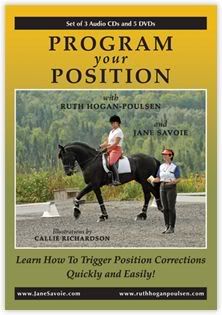 No matter where I travel, the most frequently asked questions I get are, "How do I put my horse on the bit?" and "How do I keep him there consistently?" This concept baffles many riders. My hope here is to simplify the process for you with the following information.
Get on the Bit Do you saw left and right on your dressage horse's mouth or wiggle the bit with both hands to get him "on the bit"? If you saw on your dressage horse's mouth by alternating squeezing and releasing with your hands, you're riding your horse from front to back. He might look like he's on the bit because his head is down and his nose is on the vertical, but you don't have an honest connection from back to front.
The only part of your horse's body that you can affect by sawing is his jaw. Moving the bit in his mouth encourages him to chew; when he chews, he flexes in the jaw. So, if all you do is saw on the bit, all you have control over is a flexed jaw. Your horse has a whole lot more body left over that you have no influence over.
You might think your horse is on the bit, but then wonder why he comes off the bit when you ask him to do something like a transition. The reality is that he was never on the bit to begin with. All you had was a flexed jaw.
To put your horse honestly on the bit, use your connecting half halt (see details below). Close both legs to add power from behind as if you're doing a lengthening. When your horse "arrives" at your outside hand, close that hand in a fist to capture, contain, and recycle the power back to the hind legs. Do this for three full seconds.
Then, lastly, you can vibrate or squeeze on the inside rein for two reasons:
1. To keep his neck straight - Your goal is to keep him from bending his neck to the outside in response to your closed outside hand. This means that when you ride with his soft (hollow) side on the inside, chances are you won't need any inside rein because he won't try to look to the outside when you close your outside hand.
2. To move the bit - Encourage him to chew so he flexes in the jaw.
Remember, you're riding your dressage horse from front to back if you wiggle both sides of the bit. Never do with two hands what you can do with one hand (i.e., move the bit). You have the other hand left over for the more important job of recycling power back to the hind legs.
Stay on the Bit First, you need to know that there is a specific aid to put your horse on the bit just like there is a specific aid to ask for a canter or for a leg yield. That aid is a half halt. (Don't groan...I can hear you!)
Some information on the half halt: • The reason we give a half halt is to bring the horse to a more perfect state of balance. • The half halt is the most important yet most misunderstood concept in riding. It is important not only because it is the aid to put your horse on the bit, but also because it is the doorway through which you do every change of gait, balance, movement, or exercise. • There is no stopping in a half halt. Think of it as a "half-go." Every half halt contains the power, the surge, or the thrust from behind that you'd have if you asked for a medium gait. • There is one generic, over-the-counter half halt. It consists of the momentary closure of seat, legs, and hands. • The confusion about half halts stems from the fact that there are many possible variations of that generic half halt because you can use your seat, legs, and hands in different ways. To add to the many options available, you can also vary the duration and the intensity of the half halt. • Different variations of the generic half halt create different results such as connection, collection, or preparation for something new.
To put your horse on the bit, use the version of the half halt that connects your horse's back end to his front end. For the sake of clarity, I will call this version of the generic half halt the "connecting half halt." The "connecting half halt" consists of the marriage of three sets of aids: o Driving aids (seat and two legs) o Bending aids (inside rein and both legs) o The rein of opposition (outside rein)
These three sets of aids are applied for about three seconds. To the naked eye, the aids are given at the same time. However, if you had freeze-frame photography, you would see this process:
o First, close both calves as if you're squeezing toothpaste out of a tube. This creates that surge of power from behind. You'll only be using your legs as your driving aids at this point; I'm purposely leaving the seat out for now to keep things simple. o Next, close your outside hand (rein of opposition) in a fist to capture, contain, and recycle the energy back to the hind legs. o Finally, give three little squeezes and releases on the inside rein to keep the neck straight. If you don't use your inside hand, your horse will bend his neck to the outside because your outside hand is closed in a fist for so long. o After three seconds, soften everything. Go back to the light maintenance pressure of legs and hands you had in the beginning before you gave the half halt.
Putting your horse on the bit is as simple as giving any other aid. Don't make it complicated by searching for exercises to connect your horse. Don't get me wrong, exercises like leg yields are helpful--they give the novice horse or rider the feel of connection. But at the end of the day, you need to train your horse to come on the bit from an invisible aid that you can use any time...like in the show ring!
Labels: February 2009, In Plain English, jane savoie
Cowboy Campsite Does It Again!
Paving the way to a new, more modern industry! by Duke Croney and Brian Trudeau If you aren't on the edge of your saddle waiting to see what those guys at Cowboy Campsite are going to do next, you should be. The Cowboy Campsite story began in late 2005 with the concept of an equine-only membership campground. In the last three years, the hugely successful Cowboy Campsite has grown to approximately 200 members at the Cascade Camp location near Sedro-Woolley, Washington and started the Clearwater River Camp in Kooskia, Idaho. Although Cowboy Campsite is designed for folks who own horses and want a place they can always go to camp and trail ride, countless people have asked about other opportunities like rental horses, horse leasing programs, training opportunities, weekend campouts, wrangler rides, and more. Click here to read the full cover story in pdf format. Labels: Cover Stories, February 2009
|
|


