Articles are posted here one month after their appearance in the magazine, except for cover stories, which are posted concurrently with the magazine's release.
Copyright to all content is held by The Northwest Horse Source LLC and/or the article's author. If you would like to reprint or repost an article, please contact us. Feel free to link to any article on this site from your own blog or website.
1/01/2009
Second Chances
Horse Rehab in the Real World by Catherine Madera
I knew what sort of horse I was looking for: something young and cheap. A healthy, unspoiled animal that with a minimum of invested time might be sold for a profit. That’s the story I told myself, anyway.
Scrolling down the list of hard luck and despairing ads, I knew one thing was in my favor—the season. In early December, few things are less appealing than caring for a horse in the Pacific Northwest.
It didn’t take me long to find what I was looking for. The horse fit all my criteria right down to the color; healthy weanling filly, cheap, and bay. I’ll take a conservative bay over flashy spots every time.
Unfortunately, the deal fell through. It seemed an unbelievable coincidence when, that very night, my husband stuck a piece of paper under my nose while he talked on the phone. “Free horse,” it read, followed by a phone number. All horsemen know that the Free Horse falls into the same category as the Free Car: both mostly useful as lawn ornaments. Still, I couldn’t help calling the number. It took exactly five seconds to be disappointed.
“Yep, gotta seven-year-old Arabian stallion. Got no time for ‘im.”
Further information revealed the horse was unbroke. I was invited to take a look at the stud while the owner was at work. If I wanted him, he was all mine. Anyone with good sense would have resisted the urge to see what she already knew was undesirable. I decided to take a look at the horse.
As it turned out, the horse lived close by in a narrow sliver of pasture that followed a gravel drive. He stood in a corner of his pen in the icy rain, picking listlessly at a pile of dirty hay.
At first I just stood at the gate, looking the animal over. He was small—no more than 14 hands—and missing about a third of his body weight. Skin sagged over the protruding croup bone like the sides of a collapsing tent. His neck, conspicuously missing a proud stallion crest, sprouted a head overly big for its body. A filthy pinto hide draped his skeleton; the long bi-colored mane hung in a tangle of knots. A knackers horse. Those were the words that came to mind. I approached slowly.
“Hey, pal.”
The horse looked at me briefly, then lowered his head to pick at the hay. He didn’t seem dangerous or fearful so I fit a halter on him and pulled on the lead rope. He alternated between following me haltingly and balking like a mule.
“Great. Seven years old and he can’t lead,” I said to the friend I'd brought with me. It didn’t take long to see all I needed to see.
“You gonna take him?” my friend asked as we drove home.
“I don’t know. I should just call somebody.”
No doubt somebody—a rescue, the authorities, an unsuspecting horse owner—would be thrilled to have a starving, ugly, untrained stallion dumped in their backyard, just in time for Christmas.
The horse broke out of his apathy long enough to follow the fence line after our car, nickering. I felt a pang of sympathy. I’d read all the articles about the glut of unwanted horses on the market, the ones left tied to trees or starved dead in their own pastures. I felt bad, to be sure, but there wasn’t much I could do about it. The girl who had once saved every fallen bird and feral stray had grown up and grown realistic. There was only one sensible end for that horse, and it wasn’t a good one.
But later that night as I stood in my warm kitchen, staring out the window into the inky chill, I pictured the stallion huddling in his frozen paddock. I could call “someone,” or I could see what I could do. At least I could feed him. My eye caught an early Christmas card perched behind the sink—a picture of the nativity. Christmas...the season of second chances. Maybe I was meant to do something for that horse.
I made arrangements to pick the stallion up the next weekend. Amazingly, he jumped in the trailer, legs shaking, after only a few minutes.
As anyone who has rehabbed a starving horse knows, the animal you start out with is not the animal you actually have. A few groceries work a metamorphosis that is remarkable and sometimes unnerving.
After a few days of eating grass hay 24/7, the stallion’s feed was increased to include grain and alfalfa. He began to perk up, pacing the confines of the round pen and calling to the other horses. My stomach churned as I watched his behavior. I had no experience with stallions and had foolishly allowed a horse on my property that could very likely hurt me or my family. My feelings were confirmed the day I attempted to lead “Chance” out of his round pen.
He was quiet and easy to halter. Turning my back to the horse, I began to open the gate. A sudden punch to the shoulder nearly knocked me down. Shaking, I turned toward Chance, unsure whether to drop the lead rope and run or stand my ground. He regarded me coolly, as if to say, “There, now that you know the order of things we’ll get along fine.”
After that I dug into any information on stallion handling I could find. Chance would be gelded soon enough, but the horse needed to be managed safely in the meantime. I began regular short training sessions with him that simply involved leading and, eventually, lunging.
Chance acted deceptively calm as long as he did what he wanted. When asked to move, however, he had two responses: charging and striking at the handler, or stiffening his body and bolting in the opposite direction. I learned to watch him closely to know which method he would use. Often, he gave a husky nicker just before rearing and striking. The sound set my nerves on edge.
I didn’t even attempt to be the horse’s friend, initially. Respect for human beings needed to come first. He was not allowed to approach my personal space or turn his hindquarters to me. To control his outbursts I used a thin rawhide bosal fit snugly over his nose and a dressage whip. As soon as possible I altered his gender. While that began to help with attitude, it was no magic pill for the horse’s challenging behavior.
Chance was a mess of insecurities that resulted in a horse that wouldn’t allow his feet to be handled, couldn’t tolerate the close proximity of other horses, and pulled back when tied. Additionally, the horse that had first loaded like a dream now had a violent aversion to my trailer. He pitched and plunged like a fish on a line when I tried to load him. The first time I was successful in trailering him, I arrived at my destination to an interesting dilemma. As I listened to Chance strike the trailer repeatedly and throw himself against the walls, I was as afraid to leave him in as I was to unload him.
Chance reminded me of the small, scrappy kid in school who came from an unhappy home. Always ready to punch someone out, he nonetheless wanted a friend, someone to depend on.
Progress came slowly but surely. I began riding Chance four months after bringing him home. Besides basic under saddle work, he learned to allow hoof handling and became confident in the trailer. Rather than pacing and pulling when tied, he’d stand with a leg cocked in relaxation. Though pleased with his progress, it was the horse’s mental and emotional state I hoped to affect long term. An aloof and independent spirit, his mind was hard to penetrate.
The personality changes were small at first. Chance stopped swishing his tail when I stroked him and began to show pleasure in being groomed. Instead of hiding out in a corner of the field, as close to the other horses as possible, he often lingered at my side while I worked in the pasture. And when the car pulled into the driveway, he’d whinny enthusiastically and run to the barn, bucking in glee. The look in his eye softened, too. Instead of anxious and contrary, the horse seemed to be making peace with the world.
Since meeting Chance I’ve thought a lot about rescue and horses. What it means and doesn’t mean. I’d like to say it was my horsemanship skill that reformed him, that I saw a spark of something when he was starving and ugly. But that wouldn’t be true.
I took him more out of guilt than out of sympathy, used time--not great skill--to train him, and focused on his flaws before finding his strengths. Frankly, I’ve owned easier, more talented, and better bred horses. But I’m not sure a horse has given me greater pleasure than this little pinto. He’s reminded me that, regardless of age and bad beginnings, an individual can start over.
As for the greater problem of horse welfare, there aren’t easy answers. Progress comes when individuals act, not when politicians pass a bill; when people focus on what they can do, not on what they can’t.
In the movie Seabiscuit, Charles Howard approaches Tom Smith and asks why he is saving the lame white horse. “Cause I can,” came the simple answer. “You don’t throw a whole life away just because it’s banged up a little.”
Thoughts worth pondering this season of second chances.
About the Author Catherine Madera is a freelance writer whose inspirational stories, articles, and profiles have been published in numerous magazines and anthologies. A few include Chicken Soup for the Soul, Guideposts, Equus, Horse of Kings, and Arabian Horse Magazine. To contact Catherine visit www.catherinemadera.com or view her blog atwww.thehorsebackwriter.blogspot.com.
When preparing a horse to pull a wagon or other objects, go step by step by Raye Lochert
This month's column was inspired by a reader who asked if her skittish 16-year-old horse might be taught to pull a wagon. Teaching a horse to pull wagons is usually best left to a professional. So many things could go wrong that having a pro do it is a good idea. What you can do is all the prep work prior to sending your horse to a driving trainer.
For Fun and FunctionThe prep work is primarily sacking out and getting him used to pulling or dragging objects. When I say objects, I mean tires, tarps, boat bumpers and even little red wagons. Teaching a horse to drag objects not only increases the fun you can have with your horse, but it makes him more stable, finished and useful. A horse that has been taught to drag things won’t flip out when an object gets hung up in his tail or when something is sliding along the ground toward him. You will also be able to drag objects such as branches off the trail or wood to the campsite fire pit. The possibilities are endless.
Before you Begin The first step is to make sure the horse is well sacked out. You should be able to rub a plastic tarp all over the horse, be able to throw the tarp at the horse from in front of him and out to both sides, and drag it back to you without the horse turning and running. Your horse should be trained to turn and face whatever is frightening him.
Besides being well sacked out, you should be able to control your horse in a round pen with a set of cues. Your horse should be able to turn to the inside, outside and stop on cue. Your horse should accept the saddle easily, and you should also be able to control your horse through the bridle. If these things have not been accomplished, please go back and teach these skills to your horse before teaching him to drag objects.
Creating the Pull To teach a horse to drag objects, I use a sixty-foot round pen, a well-used saddle, and a sixty-foot horsemen’s rope. This rope has a metal honda (also known as a hondo) on it for a quick release. I also gather several objects to drag. I start in the round pen to keep the horse confined while not being attached to him.
Starting in the round pen with your horse saddled, attach your horseman’s rope to the saddle horn by the honda. Send your horse off while holding the rope. Be careful not to get the coils looped around your arm, hand, fingers or any other part of your body. If you do and the rope tightens, you can get seriously injured or even killed.
With the horse moving around the round pen at no more than a trot, pull on the rope to create a pull on the saddle, and then release and repeat. This gets the horse accustomed to the pull of the cinch as you pull on the saddle. It also desensitizes the horse to a rope being out to his side in his peripheral vision. Do this several times, then ask the horse to change directions to the outside while you flick the rope up over his rump. Repeat on the other side. Work both sides several times until the horse accepts it freely.
The next step requires that you stop the horse and run the rope through the stirrup. Slip the honda off the horn--be cautious with your fingers!—and run it through from the back of the stirrup up t
hrough the stirrup and back to the horn. Now when you pull on the rope the stirrup should flip up in the air.
Send your horse out and do this in a rhythmic fashion, starting lightly, and build to a large flip. Repeat until your horse is desensitized to this. Then do it on the other side. Repeat on both sides until the horse stays calm and moves quietly.
Time Without Tension Once your horse has been desensitized to the rope in the manner described above, it is time to get him used to ropes around his hock and hip area. With the rope attached to the horn (removed from the stirrup) send your horse out and ask for an outside turn. This time when the horse changes directions, let the rope hang low and end up around his hip. The rope should be attached to the horn and drape down his opposite side (the side you are not on) and come around his hip across his hocks. Don’t put tension on the rope; just let him get used to the feeling. Some horses will kick, some will run faster. If he kicks, let him. If he runs faster, cue him for an outside turn and slow him down. Don’t let things get out of control.
The key to all of this is patience. Work with the horse until he's ready; don't leap ahead because you really want to get him in front of that wagon.
Next month, we'll look at how to begin adding resistance to the ropes and slowly increasing what you ask your horse to pull.
Maria Danieli Wins 2008 Snaffle Bit Futurity $5K Non Pro Limited
Although Maria Danieli owned the 2007 National Reined Cow Horse Association Snaffle Bit Futurity Open Two Rein Champion, she had never competed at the elite reined cow horse event. That changed in 2008, as she won the $5K Non Pro Limited class on Doc Gin With A Twist.
Danieli was quick to thank her trainer, Mike Helsen, for his help. Helsen, who showed Doc Gin With A Twist in the Open Two Rein, won the Open Two Rein on Danieli's horse, Hi Smokin Rooster, last year.
For more information on the National Reined Cow Horse Association, visit www.nrcha.com. Also, find out about Maria Danieli's equine property listings in the KingCounty area at www.mariadanieli.com or see the inside front cover of this magazine for select listings.
***
Shared Hope for Healing's Holiday Wish List
Shared Hope for Healing, an Equine Assisted Psychotherapy and Personal Development organization, is in need of the following items and resources.Please consider donating items this holiday season.
People Needed:
Volunteer Executive Director (to become paid position once funding is available)
I tested the model #AGC2 with a wide blade. This really gets the job done fast. I do very little body clipping (other than in winter), but for the face, bridle path and legs this unit is great. The 2-speed motor makes the job go pretty quick and the shape of the unit makes it easy to handle. It’s fairly quiet and comes apart easily for cleaning.
The other real plus with these clippers is the exceptional training video that comes with them. I do my own clipping, so it’s always great to have some guidance. The brand name Andis has been around since 1922, so I would consider this unit a good buy.
A DVD Review by Sineka Tornquist-Cragin, NWHS Intern
Any Horse, Any Rider has a unique approach to understanding a horse's movements.Each chapter of the DVD is designed to show independent movements to teach independent work.
Michelle Binder combines natural techniques with dressage training to give you the best possible horse and rider relationship for all disciplines, based on a common principle: natural movement.For Western pleasure, hunters, jumpers, eventers, dressage riders and more, Binder believes every horse is worthy of love, trust and respect. She builds on this belief and working with the natural movements of the horse to create a program that is designed to cross boundaries between all disciplines and breeds.
***
Washington State Animal Response Team Provides a Vital Service
The Washington State Animal Response Team (WASART), is a grass-roots, non-profit 501(c)(3) organization created in 2007 to serve as a unifying network of organizations, businesses, agencies and volunteers that support the preparedness, response, and recovery efforts directed at helping livestock and other animals affected by disasters or emergencies.
Based in Enumclaw, WA, WASART has trained members in King, Pierce, Thurston, Kitsap, Ferry, Mason, and Grays Harbor counties and currently provides services within Western Washington. The organization specializes in the physical rescue of animals that are in dangerous or life-threatening situations, and in providing food and water to temporarily abandoned animals. While WASART’s focus is primarily the large animal population such as horses, mules, alpacas, etc., WASART will respond, with the resources available, to the evacuation of all animals.
Visit www.washingtonsart.org for more information including scheduled meetings, training sessions, and how to become a part of the effort.
Part one in a new series following the training of horse and rider for reining competition by Allison Trimble
The main reason I began writing this column was to encourage more people to become involved in the reining, cowhorse and cutting industries. I have known Karen Pickering since I moved to Whatcom County in 2000. Her contribution to the Northwest equine community is great and she is always encouraging people to get out and ride and to try new things. I think the story of Karen and her horse, April, is one that is written every day in the lives of many of my readers. I hope that sharing with you her journey to move forward will inspire you to do the same. Over the next few months, we will be following Karen’s path as she works toward getting into the show pen next season.
Beginnings As a girl and young adult, Karen had ridden rank horses without fear, but about 15 years ago, she was in a horse wreck and her confidence was a bit shaken.
Karen purchased April as a yearling in 2000 with the hope of having her first reining horse. She sent April for about eight months of professional training as a young horse, and for the past few years Karen has ridden her all over on the trails and has shown in some local reining shows. Now a nine-year-old, April is kind, easy to get along with and gentle. She can be left for weeks without work and still handle a rider on her back as she heads down the trail.
Like many of you, Karen has the horse she wants, but is looking to find a way to take this horse and show her in local reining events.
Last week, Karen and April came to my place for our first session. I put Karen on a finished horse of mine and hopped Karen's gray beauty. As we walked around, we identified as many of the obstacles that Karen was facing as we could. One of the main suggestions that I had was that I thought the team would greatly benefit from Karen improving her skills separately from April learning her role. I believe that the two of them will come back together as a stronger team.
Karen's Experience At that time, I discovered Karen was quite downtrodden about her lack of ability at a lope. She could not get April to “pack her head” at anything other than a walk. Karen felt that she was unable to sit the lope and was all over the place when she tried to do maneuvers. She also felt uncertain where to start with controlling her hands.
We spent some time having her lope around on my mare Jane. Jane is not an overly "feely" horse, and she will easily tolerate a person being a little off target. Karen really did very well on a finished horse, so although she will certainly benefit from continued riding on a finished horse, the problem was not all hers.
April's Experience April was ready for a fight as soon as I threw a leg over. Don’t get me wrong, she wasn’t trying to hurt me, she was just immediately tense and resistant. She is an extremely “feely” horse, very sensitive to legs and hands. That is a great thing in the hands of someone used to it, but is not always a great trait in a non pro horse.
I tried to lope a handful of circles. We were all over the place. It didn’t take me long to understand why Karen was feeling uncomfortable at a lope, because I was starting to feel like I couldn’t ride. April was just so touchy that she was very easily bothered. She was wiggly in her face, wiggly in her body, and because of it, had no cadence in her movement. She also has a long history of going to clinics and lessons and having all manner of new ideas and techniques thrown her way, which has caused some nervous habits.
In my experience, a mare like this--super sensitive and wobbly, and especially a horse with some age on her-- needs the kind of stability that a bit can offer. I went in the barn and got a Billy Allen bit from the tack room and put it on her. It took about ten minutes of moving around before she would let me pick up my hands and rock my legs on her belly. Then she rounded up and dropped the elevation of her head and rounded her back.
While I worked with Karen on learning to do the same thing on Jane, I trotted and loped around on April, working on getting her relaxed and cadent. We were also able to identify that with her shorter legs, Karen needed spurs that turned down so she wasn’t spurring April every stride. Spurs are important for cueing, but can be very annoying, especially to a sensitive horse, if they get it in the sides all the time for no reason.
The huge negative reaction April was having to Karen’s legs and hands was largely caused by her sensitivity. That same sensitivity, when properly handled, quickly turned into a soft and willing partner. It was such a dramatic difference when she understood. She truly is one of the softest horses I have ridden.
The Second Session The second session was a night and day difference. April started out right where we left off. Karen continued to work with Jane on the same things I was working on with April. This session, April loped right off on a relatively loose rein and let me handle her around at a collected and cadent lope. Karen and I talked a lot about really simplifying things with a horse like April. We charted a path where we would work on building both of their confidence through things like steering, softness and collection.
At the end of the ride, Karen moved from Jane to April and we went through the same exercises. With the new confidence that she could get a horse to go around looking the part, Karen was able to lope around on April and look like a reiner. The smile on her face and her obvious boost in confidence were great. It was the moment when I think she first realized that it was possible. Our little team has a long way to go, but this was a big step in the right direction!
From Karen’s Mouth “Allison and I will be tracking this journey and hopefully we'll give some of you insight into having more success with your horse no matter what direction you take. I'm liking the lesson program with Allison where I'm on a finished horse and she's working mine.
I believe we all need to do what matters most to us. My goal is to get more enjoyment out of my arena riding, learn some new things and be somewhat competitive at the local level.”
Training Your Own Horse – Part 6 of a 6-part series
Use of the Whip by Alice Trindle
For those of us who most often ride in Western tack, the concept of riding with a whip may be foreign. As I heard Curt Pate describe once, "It is difficult to hold a dressage whip when you are roping!" However, as we study horsemanship and listen to the masters from many continents, we discover that the whip--when used mindfully--has many benefits for every discipline.
By "whip" I mean a family of extensions of our arms, ranging in length from approximately one to two meters. Unfortunately, this tool has been characterized as a torture device for horses. In the right hands, with clear purpose, it can have many useful and honorable attributes.
Purposes of the Whip Artificial Aid The natural aids include seat, leg, hands, and focus. Artificial aids, such as the whip, spur, and rommel, should be used as reminders of the clear intentions we first establish through the natural aids. I don’t want to create a situation in which my horse only moves due to the tap of the whip. Rather, I will use the whip to remind him to move after my focus, seat, legs, and hands say “Go!” The whip should not become a crutch.
Extension of Your Arm or Leg For those of us who are vertically challenged, (i.e., a little short and riding a rather large horses or rather tall and riding a smaller horse), the whip can be an excellent way to communicate to specific body parts without negatively affecting our body position or giving mixed, confusing signals with our legs. Being on the short side myself, and often riding rather large horses, I have to be very careful about the use of my leg pressure, particularly if I am wearing spurs to enhance the movement. I cannot get my leg back to influence the hip or some lateral movements without touching the horse too high on his ribcage. The dressage whip can allow me to keep my seat, hands, and focus in the correct position while using the whip to point and talk directly to the body part that needs to move.
Enhance Movement & Balance In your groundwork, round or square penning, work-in-hand, developing high school maneuvers, and in riding, the whip can be a wonderful tool to help enhance movement, balance and clear communication of your intentions. Exercises using two whips can greatly help your balance and posture in the saddle, as well as enhance the balance of your horse.
Develop Your Multi-tasking Skills Combining clear leadership, focus, balance, rhythm, timing, and feel together with another living, thinking, feeling creature is not easy. Any time I can further advance my multi-tasking skills, I know I am on the right track.
Use as a Reprimand Schooling and learning require some measure of discipline: • The discipline of providing good leadership for our horses • The requirement to care for our animals • The appropriate demand of a response from our horses
The word discipline should first relate to the human’s role of instructing, guiding, and educating both our horses and ourselves. Using the whip to correct should always happen with mindful intentions, in which you clearly have pictured the correct response and are ready to reward the slightest try in that direction. The use of the whip to discipline the horse must be u
sed in that mindful sequence, and never used as punishment.
Tradition & Honor A final purpose of the whip is related to the traditions of riding schools and the honor one earns after many years of study. To ride with a willow stick is one of the highest honors afforded in many riding schools across the globe. Similar to our true vaquero tradition of earning the honor to ride straight up in the bridle with the rommel reins attached with one horse hair to a beautiful spade bit, you only earn the right to carry a willow stick as a whip after many years working with and studying horses.
Cautions for Using the Whip • The whip is not to be used for punishment. There is no room for that type of aggression with horses. • Avoid using the whip in a nagging or nit-picking manner, particularly without clear intentions of the desired outcome. • Do not use the whip for trailer loading education. The whip has a bite to it, and this can distract from the desired intention of sending the horse into the trailer. In frustration, the horse will often kick up at the whip and not focus on the right answer of flowing into the trailer. Instead, I use a whirl of the end of the lead rope or an extension of my arm like a fiberglass/carrot stic
k, or team up with another knowledgeable human. • Be vigilant about the end of the whip when it is around the horse’s eyes. In particular, the popper end of the lunge whip can cause serious injury to the eye. Be Careful!
Exercises For a review of general work in hand exercises and liberty work, visit www.tnthorsemanship.com/articles. You can also review last month's article on liberty work, either there or at www.nwhorsesource.com.
Ski Poles and Swords This is one of my favorite riding games that uses either a whip or a fiberglass stick. The basic principle is to use the whip as a visual aid to get the human to free up the upper and lower body, focus, and allow the horse to accomplish more with less. While holding the whip as if it were a ski pole, put a slight twist in your torso and bring the ski pole back toward your horse's flank, as if you were planting the pole vertically. This movement and positioning will affect the horse's hindquarters. If accompanied by getting the inside eye and a little inside rein, you will affect the horse’s inside hip and hind leg to cross under the belly.
Next, switch to holding the whip as if it were a sword, and place it in your outside hand. As you direct the inside eye for a change of direction using the inside rein, extend the sword forward, as if to reach around the outside arc of the circle in the direction of travel. This movement and position will affect the forequarters of the horse.
To begin with, I use the whip in this exercise on a series of half turns, or changes of direction with forward motion. For example: • Start tracking to the left with the whip in your left hand as if it were a ski pole. • Now think of changing directions around your left leg and flowing back off to track right. Your left hand will have the left rein and your ski pole. • Put that twist in your torso, opening your shoulders by drawing back on your left hip and bringing your right shoulder forward. The whip is placed perpendicular to the ground (ski pole position), near the flank. Don’t dip your shoulders! • Once you have accomplished the change of direction by stepping the left hind foot under the belly and you are riding off to the right, you are ready for the sword. • Change the whip to a sword position. See in your mind's eye a half turn change of direction around your right leg. Look right, slightly guide the right eye with your rein, and extend the sword out in an arc to affect the left eye until you have changed directions.
Advance this exercise by riding with two whips – the inside of the bend contains the ski pole, and the outside of the bend holds the sword. Soon you will be riding with little or no rein and experiencing the joy of your horse following your natural aids with the help of the whip!
Author's Note It has certainly been my pleasure over the past 12 months to write these articles for the readers of Northwest Horse Source. To share what the horses have been teaching me is truly a gift from the Creator. In this month of spiritual celebrations, let’s remember how fortunate we are to have horses in our lives!
Creating the Perfect Paddock, Part 1 in a 3 part series
Create the best possible paddock for horse, human and environmental health by Alayne Blickle, Horses for Clean Water
Tired of confining your horse in that muddy, dusty, smelly and fly-infested pen? Are you looking for some new ideas on how to care for your horse during the winter months or rainy season? Or where to keep your horse when your pastures are on the brink of being overgrazed? Or when your horse is in need of a “diet pen”? Having a horse-friendly, easy to care for paddock for your horse is central to horsekeeping. The bonus for you is that having the perfect paddock will be better for horse health, more chore efficient for you, nicer for all to see and cleaner for the environment. In this series we cover key techniques for setting up and managing a horse paddock, including location, footing, and fencing as well as controls for mud, insects, odors, and dust. We begin by looking at where to locate a paddock and how big it should be.
The Problem with Mud Living in mud is unhealthy for a horse. Mud harbors bacteria and fungal organisms that cause diseases such as Scratches (pastern dermatitis), rain scald (also known as rain rot), thrush and abscesses. Mud is also a breeding ground for insects, especially filth flies and mosquitoes -- a big concern for all of us now with West Nile Virus in most of our neighborhoods. Horses fed on muddy or dusty ground can ingest dirt or sand particles, leading to sand colic, a very serious digestive disorder. Mud also creates a slick, unsafe footing that can cause slips and injuries for horses as well as humans. As all horse owners know, mud is extremely inconvenient, making barn life unpleasant and an eyesore for all. And the summertime version of mud is dust – unhealthy for us, our horses and our neighbors.
Probably the most important aspect of managing pastures is the time when you take your horses off your pasture. You can greatly improve the health and productivity of your pastures by creating and using a paddock (often called a “sacrifice area” since you are sacrificing that area as grassy pasture for the sake of the rest of your pastures), while allowing your pastures a rest period. For pasture health and productivity, it is important never to allow pastures to be grazed below three inches. Once grass plants are grazed below that amount, they begin losing vigor and strength; the downward spiral of bare soil, dust and weeds begins to take hold.
The perfect paddock also offers good environmental controls with fewer run-offs of sediments and nutrients (from mud and manure) that are harmful for creeks and drinking water. More productive, grassy pastures will hold onto valuable topsoil and filter out nutrients and sediments – more pluses for the environment. All of this adds up to bonuses for everyone.
The Right Spot If you don’t already have a location for your perfect paddock, begin by choosing an appropriate site. • Choose an area on higher ground, away from creeks, wetlands or other water bodies and well away from surface water flows. • If possible, choose well-draining soils, not organic, mucky ones. • Look for a slight slope (about 1 to 2% is optimal) that will drain away from your barns and confinement areas. • For chore efficiency, your confinement areas should be convenient to your barn and manure storage area.
One paddock per horse makes it easy to monitor each horse’s health as well as intake of food and water. It also helps to alleviate problems that might occur during your absence, like ending up with a fat horse and a skinny horse, or an individual that might trap a subordinate in a corner. Having horses in adjacent paddocks so they can see each other helps alleviate stress. If you have a barn with stalls, you may find it easiest to set up paddocks as runs off of each stall. This chore efficient arrangement gives the horse free access to a paddock to move around in as well as the stall for shelter and a clean, dry, convenient place to feed.
The size of a confinement area can vary from that of a generous box stall, say 16' x 16', to that of a long, narrow enclosure where a horse can actually trot or even gallop about to get some exercise. If you want your horse to be able to run or play in his paddock, an enclosure of about 20' or 30' wide by 100' long is recommended.
The amount of land you have available, the number of horses, their ages, temperaments and the amount of regular exercise they receive all play an important role in determining the size you choose to make your paddocks.
Next month we continue with part 2 of Perfect Paddocks: Manure and Mud Management, where we'll look at fencing considerations, safety tips and chore efficiency ideas for your horse’s outdoor living quarters.
One woman's passion for learning creates a sanctuary for horses with special needs By Nicole Lanphear
In the realm of holistic horse care, there are veterinarians, chiropractors, acupuncturists, nutritionists, farriers and more. One Montana woman looked to combine the breadth of knowledge into one central location to better serve horses and horse owners that have special needs.
In Bozeman, Montana, a woman named Judy Smaaland offers a retreat for horses who need more supervision or attention than most boarding barns can offer. She works with a handful of alternative practitioners, including chiropractors, acupuncturists, homeopaths, massage practitioners, and natural hoof care farriers to form a central location to treat various needs.
Smaaland had horses off and on since she was a child, and five years ago got back into the horse world with a vengeance. She had become involved with natural healthcare for herself and her small animals, and began to see more and more health issues in horses that could benefit from a similar kind of care.
“I’m seeing a lot of horses come through with digestive, chiropractic issues, or general health challenges,” says Smaaland.
She saw a need in her community for a place where horses with special needs could get the kind of care that regular boarding facilities couldn't offer.
This summer, she converted her barn and pastures to accommodate rehabilitation and a surgical recovery center. Along with a local vet, she works with horses from stall confinement through the healing process in different pens, corrals and pastures suited to their needs.
Each horse is unique, and Smaaland tailors her routine to each boarder’s needs and feeding schedule. One of her current horses foundered in the past, so he is turned out on a strictly timed schedule with a grazing muzzle. Another horse is a former dressage mount whose eye was kicked out by another horse. Smaaland watches him closely and works to build his trust.
Providing Peace of Mind A hands-on approach and intensive supervision provide the horses at Smaaland's stable with the care they need, but it isn't just the horses who benefit. Owners, too, appreciate the time and attention spent on care, offering peace of mind to those who cannot provide full care themselves.
Whether it is soaking abscesses or administering medication, “It is fun to see what can be done,” says Smaaland. “Within the confines of what can be done, a prognosis can change.”
Building a Network “I love seeing horses get better,” Smaaland says. “Their healing capabilities are amazing, given the right tools. I’ve seen them come around so quickly.”
Smaaland’s larger goal is to provide her services on more of a consultation basis, rather than at her physical location. She wants to bring together a network of people who have the desire to continue learning and meeting the needs of their horses through natural options. She loves being a constant student of horse care and recommends that anyone interested in starting up a facility like hers bring together as many human resources as possible.
“Networking is wonderful,” she says. “Bringing together people of like mind. It greatly increases the services we can all provide.”
The Clydesdale is a breed of heavy draft horse developed in the early nineteenth century by farmers in the Lanarkshire (previously Clydesdale) district of Scotland. It was bred to meet not only the agricultural needs of the local farmers, but also the demands of commerce for the coalfields of Lanarkshire and for all the types of heavy haulage on the streets of Glasgow. Due to its fine reputation, use of the breed soon spread throughout the whole of Scotland and northern England.
Heavy horses were originally developed for use in warfare to carry armor-clad knights into battle. Scottish farmers later began using some of the larger English and Flemish stallions on the smaller local mares. They eventually produced a powerful horse with a long stride and a sizable hoof, perfect for working in the soft soils of the rough Scottish farmland.
The versatility of the breed is evidenced by the increasing number of equine activities for which it is used. Popular with carriage services, the Clydesdale is well suited for the job and always attracts public admiration. Under saddle, the Clydesdale excels in many pursuits including dressage, hunter jumper, as a trail horse, and for therapeutic riding.
The Clydesdale has a very distinctive look when compared with other draft breeds. The combination of vivid body colors, bright white faces, and long white "feathered" legs with a high-stepping gait and a head held high leave no question that you are looking at a Clydesdale. The most common body color is bay, followed by black, brown, and chestnut. The roan trait (solid body color with white hairs throughout the coat) may be found in all the colors.
For anyone desiring a stylish and active yet tractable, intelligent and serviceable draft animal for work, show, or simple pleasure, the Clydesdale merits his or her most serious consideration.
Information and photo provided by the Clydesdale Breeders of the U.S.A. For more information visit www.clydesusa.com.
One horse's journey from neglect into health by Dave Sauter, DVM, Kulshan Veterinary Hospital
Dealing with an animal neglect case can be a heart-wrenching experience. Unfortunately, animal neglect happens and someone has to cope with the consequences. With rising feed costs and hard times economically, such cases are regrettably on the rise. Today’s article is a story describing one such instance. In this situation, as in many cases of neglect, the owners simply lacked the knowledge and experience to care for the number of horses they had. The resulting condition of some of their horses was life-threatening.
The Whatcom Humane Society (WHS) is the designated animal control agency of Whatcom County, assigned with the task of enforcing the codes, regulations and laws concerning animal care. They were called on earlier this year to investigate a case of animal neglect involving a large group of horses. The WHS examined all of the horses at the location and also inspected the shelter, the amount of space for the number of animals, the availability of feed and water, feed stores, fencing, etc. Ignorance of basic feed requirements had caused three of the horses to be at a state of starvation that was life-threatening. The WHS used its legal authority to seize the three horses. One of these three emaciated horses was “Red” (named by her eventual adoptive home). Based on her teeth and appearance, she was a twenty-something chestnut Arab cross mare. One of the other two horses was Red’s three-year-old daughter.
When the WHS removes horses in an emergency situation like this, they need a suitable location to provide food, water, safe housing and proper medical attention for the horses until a permanent new home can be arranged. Generally, one of several horse rescue facilities is called upon, but at the time of this seizure all the local facilities were full. Fortunately, a “foster home" was found. A local animal lover with a big heart, Lynn Larson, agreed to take Red and her daughter temporarily. Lynn has taken in foster animals before, including peacocks, llamas and poodles. In fact, she recently was awarded the WHS Act of Kindness Award. Lynn teamed up with a veterinarian, Dr. Christine Monroe, to tackle the horse rescue project. The starved, lice-infested, wormy pair of horses were taken in with loving arms. Proper food, water, shelter, blankets, and medicine for the internal and external parasites were generously provided. Lynn and Christine grew especially fond of Red because of “her kindness and will to live.”
After about a month in foster care, a home was found for Red and her three-year-old daughter. The new owners were initially very enthusiastic. Unfortunately, the two horses were more of a project than expected and they became too much of a burden. Red and her daughter returned to Lynn’s.
The filly’s condition improved faster than Red’s, and with that and her more youthful years, it wasn’t too long before a suitable home for the filly was found. Red, however, wasn’t improving as quickly. Although she gained greatly in strength and energy, she continued to look horribly underweight and rough. With her advanced years, a willing home couldn’t be found. Several people came out to look at her, but quickly lost interest and left. As the weeks turned into months, the options for Red were dwindling. The WHS was struggling to find homes for numerous horse cases. In spite of the fondness for Red, time, patience and resources were running thin.
Red’s guardian angel came in the form a veterinary assistant intern named Ruben from the Bellingham Technical College. In addition to his veterinary assistant duties, he was working for Lynn and knew about Red. While interning at Village Veterinary Hospital, he told one of their veterinarians, Dr. Rachel Bangert, about Red. He told her how Red had been starved, how Lynn and Christine had been providing a home for her for over three months, and how, because she couldn’t be placed into a permanent home, she might have to be euthanized. Although Red had improved considerably over the three months, her condition was still very poor. It wasn’t clear if she could ever recover from her emaciated condition. In spite of these doubts, Rachel and her husband, Ken, decided to take Red into their home and continue the battle to save her. The kindness in the mare's eyes may have influenced their decision.
After several more months of patience and numerous bills for feed, blankets, lab tests, deworming, trimming, delousing powder, dentistry, etc., Red has finally returned to good health, seven months after WHS seized her. She has made an incredible transformation from a near death rack of bones with a gut full of worms to an easy keeper that may need to go on a diet. Rachel has even started riding her. And she still has her kind eyes, which are perhaps a bit more grateful to be in her new home.
A few observations concerning the subject of neglect: • Horses that have been starved so severely that they have lost over 50% of their normal body weight are much less likely to survive. • Taking on a starved horse is a formidable project. There is no guarantee of success and there is a lot of potential heartache and expense along the way. • The WHS and the various local rescue facilities are always in need of financial support. Donation is another way to try to help these horses out. • Feeding starved horses requires great care and patience. Starved horses are depleted of fat and carbohydrate stores and are burning protein from muscles for fuel. Their bodies are running in an altered metabolic state and they cannot be fed like normal horses. Feeding concentrated calories to the starved horse can lead to heart, respiratory and kidney damage, not to mention colic. Instead, numerous meals of good quality forage are recommended. Consulting with your veterinarian to outline a feeding program after an examination and laboratory tests is highly advisable. • Expect six months or more for the emaciated horse to recover. Emaciated horses are in a fragile state – be patient. Feed changes must be gradual. • Not all skinny horses are skinny because of neglect. Some skinny horses have owners who love them and provide them with everything possible to keep them as healthy as possible with special feed and care to try to get weight on them. Some old horses are like some very old people who simply stay skinny. Some of these old, skinny horses are active, happy and love to eat the gruel their owners provide. They have proper shelter and regular farrier and veterinary care. These horses do not need to be seized and the decision as to if and when they should be euthanized is between the owners and their veterinarian.
He was bred to be a champion. He was born to run. Everyone said he would be one of the greatest racehorses of all time. Everyone said he would take a place in history next to Triple Crown winners like the fabled Secretariat.
Then, in one sickening, heart-stopping moment, everything changed. Suddenly he was no longer racing for glory; he was fighting for his life. And the horse bred to be a champion became much more: he became a symbol of hope and courage for an entire nation.
Though designed for young readers (ages 7-12), BARBARO: America's Horse is a book that speaks to all ages. Based on interviews but fictionalized just enough to create the dialog that tells a compelling story, the book brings back to life a horse that captured a nation.
Shelley Fraser Mickle lives on a farm in Florida with her two horses, Precious and Mullet. She is the author of several novels, including The Queen of October, a 1989 New York Times Notable Book. This is her first nonfiction book and her first book for children.
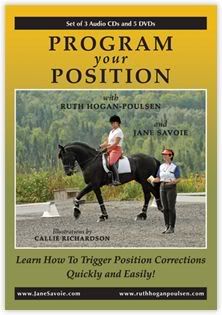
Sit straight and feel when each of your horse's hind legs hit the ground by Jane Savoie Even if you're not a dressage rider, it's still important to sit straight and square in the saddle. Can you tell if you're collapsing at your waist and sitting crookedly?
Are You Sitting Straight? Ask a ground person to stand behind you and have them answer the following questions:
1. Are your shoulders level (i.e., the same height)?
2. Is your seat in the center of the saddle so that each seatbone (the bottom of the pelvic bone; in technical terms, ischial tuberosity) is the same distance from the middle of the saddle?
If one shoulder is lower than the other, then you're collapsed at your waist and your seat isn't in the middle of the saddle. Let's say you've collapsed the left side of your waist; in this case, your left shoulder is lower and your seat is off to the right.
1. Bring your right seat bone over and place it on top of an imaginary line that runs down the center of the saddle from the pommel to the cantle. You won't really be on top of that line. You'll just end up sitting in squarely.
2. Stretch your left arm straight up so it passes by your ear and your fingers are pointed straight toward the sky. Feel how that elongates your left side.
3. To keep yourself straight and stretching tall as you ride, pretend you have two sticks of equal length between your last rib and your waistband. If you collapse again, you'll get jabbed in the ribs by the stick on the left side, and the stick on the right side will end up on the ground.
Once you're sitting straight, get a feel for your horse's footfalls with the following tips.
Influence the Hind Legs Can you feel when your horse's hind legs are on the ground? This is an important skill to develop because you want to time your leg aids so that you give them when your horse's hind leg is on the ground, specifically just as it's getting ready to push off. That's the only time you can influence a hind leg.
I feel where the hind feet are by feeling my horse's hips. When a particular hind foot is on the ground, my horse's hip is higher on that side. It feels like my corresponding seatbone is being pushed forward.
Here are some tips to help you learn to feel when a hind leg is on the ground:
1. As you ride your horse at a walk, close your eyes. Focus on, let's say, your inside seatbone. Some people describe the feeling as their seatbone being higher. Others describe it as feeling like it's being pushed forward. Each time you feel your seatbone being pushed forward or higher, say the word "Now." Your walk should be a series of "Now, now, now...." That way you can get into the timing of when that hind leg is on the ground.
2. Ask a friend to call out "Now" each time a certain hind foot is on the ground. Coordinate what your friend says with the feeling under your seat.
3. If you're working alone, sneak a peek at your horse's shadow or a mirror if you have one. Check that you're feeling the right thing by calling out the footfall and looking at the shadow or mirror to see if you're right.
4. Watch other horses and riders and notice where both the horse's hip and the rider's hip are when a particular hind leg is on the ground.
5. Teach yourself how to feel when the inside hind leg is on the ground in the canter by watching your horse's mane. It flips up during the second beat of the canter when the inside hind leg is on the ground. Say "Now" each time you see it flip up. Then you can coordinate what you're seeing and the word "Now" with what you're feeling under your seat.
Over the course of the past twelve months, Northwest Horse Source magazine has grown and changed quite a bit. This issue, we’d like our staff members to tell you, in their own words, a little bit about what that has meant to them.


 The next step requires that you stop the horse and run the rope through the stirrup. Slip the honda off the horn--be cautious with your fingers!—and run it through from the back of the stirrup up t
 Time Without Tension
 While holding the whip as if it were a ski pole, put a slight twist in your torso and bring the ski pole back toward your horse's flank, as if you were planting the pole vertically. This movement and positioning will affect the horse's hindquarters. If accompanied by getting the inside eye and a little inside rein, you will affect the horse’s inside hip and hind leg to cross under the belly.
  Next, switch to holding the whip as if it were a sword, and place it in your outside hand. As you direct the inside eye for a change of direction using the inside rein, extend the sword forward, as if to reach around the outside arc of the circle in the direction of travel. This movement and position will affect the forequarters of the horse.